Walk down the lock aisle at any hardware store and you’re looking at a hundred years of security engineering crammed onto four shelves — brass deadbolts that would look at home in 1925 sitting next to fingerprint locks that talk to your phone. For a Buffalo homeowner just trying to secure a front door, it’s genuinely confusing. What’s the difference between a Grade 1 and a Grade 2 deadbolt? Is Kwikset’s SmartKey actually secure? Do you need a hub for that smart lock, and will it survive a Western New York winter? This dictionary answers all of it, in plain English.
We built this as the most complete residential lock reference on the web: every major brand explained, every lock type broken down, the full landscape of smart and AI-driven locks, and the security standards that actually mean something. It’s written by working locksmiths — the people who install, repair, and open these locks every day across the Buffalo metro — not by a marketing department. Whether you’re buying your first deadbolt, upgrading a rental, or trying to figure out if a $300 smart lock is worth it, start here. For anything you’d rather hand to a pro, Defense Locksmith covers the whole 50-mile Buffalo metro.
“People overpay for the wrong lock and underpay for the right one all the time. A gorgeous $250 handleset on a hollow door with a short strike screw is worthless — a burglar goes through the frame, not the lock. Understand the parts, the grades, and how they fit your actual door, and you’ll spend less and be safer. That’s the whole point of this guide.” — Simon Goodman, owner, Defense Locksmith
Jump to a section
Reference tables: Lock grades · Brand overview · Lock types · Smart connectivity · Smart lock models
Sections: Lock brands · Lock types · Keyways & key control · Smart locks · AI & the future · Standards & ratings · How to choose · FAQ
Reference Table 1: Residential Lock Grades
Nearly every quality lock carries an ANSI/BHMA grade. It’s the single most useful number on the box, and most shoppers ignore it. Here’s what each grade actually means for a home.
| Grade | Best for | Roughly what it survives | Real-world take |
|---|---|---|---|
| Grade 1 | Exterior & high-security doors | The most operating cycles and the hardest strike/impact tests | Commercial-level strength. Worth it on a main entry door you care about. |
| Grade 2 | Most residential exterior doors | Heavy residential use, strong impact resistance | The sweet spot for homes — strong, affordable, widely available. |
| Grade 3 | Interior & low-risk doors | Basic residential duty | Builder-grade minimum. Fine for a bedroom; light for a front door. |
Reference Table 2: Major Residential Lock Brands at a Glance
| Brand | Known for | Common keyway | Typical tier |
|---|---|---|---|
| Schlage | Strong deadbolts, wide availability | SC1 / SC4 | Mid to high |
| Kwikset | SmartKey re-keying, value | KW1 / KW10 | Budget to mid |
| Baldwin | Forged-brass luxury hardware | SC1 or C keyway | Premium |
| Yale | Heritage & smart locks | Y1 / para | Mid to high |
| Weiser | Canadian value, SmartKey-based | WR5 / KW1 | Budget to mid |
| Emtek | Designer & decorative trim | SC1 or KW1 (your choice) | Premium |
| Medeco | High-security, patented keys | Medeco restricted | High-security |
| Mul-T-Lock | Pin-in-pin high security | Restricted | High-security |
| ASSA / Abloy | Disc-detainer, near pick-proof | Restricted | High-security |
| Defiant | Home-center budget locks | KW1-style | Budget |
Residential Lock Brands, Explained
The brand on your lock tells you a lot: the keyway your keys are cut on, the security ceiling you can reach, and whether spare parts and rekeying will be easy or a headache. Here are the names a Buffalo locksmith works with every week.
 Schlage. The default recommendation for a strong American residential lock. Owned by Allegion, Schlage is known for genuinely tough deadbolts — the B60 and B360 lines are the ones most homes should be looking at, and Grade 1 options exist. Keys run on the SC1 (five-pin) or SC4 (six-pin) keyway, among the most common in the country. Schlage’s Primus and Everest lines add sidebar-based pick and key-control resistance for people who want more. If a customer asks us for “just a good, solid deadbolt,” this is usually where we point them.
Kwikset. The value leader, made by Spectrum Brands, running on the ubiquitous KW1 keyway. Kwikset’s signature feature is SmartKey — a re-keying technology that lets a homeowner reset the lock to a new key in about 30 seconds with a small tool, no disassembly. It’s fantastic for renters and new-home buyers. The trade-off: early SmartKey cylinders drew criticism for being vulnerable to a determined attack with a specialized tool, and they resist traditional picking but not all bypass methods. For most homes it’s plenty; for high-risk doors we suggest stepping up. See our lock rekey services for either system.
Baldwin. The luxury name. Baldwin builds forged-brass handlesets and deadbolts with a weight and finish quality you can feel — the hardware architects spec for high-end Buffalo homes. Many Baldwin products hit Grade 1 or 2 while still looking like jewelry. You pay for it, and the aesthetics are the point as much as the security. Baldwin can be keyed to SC1 so it plays nicely with other locks on the property.
Yale. One of the oldest names in locks — Linus Yale Jr. invented the modern pin-tumbler cylinder in the 1860s. Today Yale is part of ASSA ABLOY and spans two worlds: traditional mortise and cylindrical locks, and a leading smart-lock line (Yale Assure). If you want a heritage brand that also does app-controlled deadbolts, Yale is the natural bridge. See the smart-lock section for the Assure family.
Weiser. A Canadian brand, big in the northern US and Western New York, also under Spectrum Brands and built around SmartKey re-keying much like Kwikset. Solid value, easy to rekey, and readily available in the Buffalo market. Weiser and Kwikset cylinders are close cousins.
Emtek. A designer-hardware brand (part of the ASSA ABLOY / Yale family) known for decorative levers, knobs, and handlesets in a huge range of finishes. The clever part: Emtek lets you choose your keyway — typically Schlage (SC1) or Kwikset (KW1) — so the pretty hardware still matches the rest of your keys. Style-forward homeowners love it.
Medeco. When security is the priority, Medeco is a top answer. An ASSA ABLOY high-security brand, Medeco cylinders use elevated, rotating pins plus a sidebar, earning UL 437 listings and strong resistance to picking, bumping, and drilling. Keys are patented and restricted — nobody copies them at a kiosk — which gives you real key control. Common on gun rooms, pharmacies, and homes that have had a break-in.
Mul-T-Lock. An Israeli high-security brand (also ASSA ABLOY) famous for its telescoping pin-in-pin design: each pin is actually two, doubling the effective complexity. Patented, restricted keys and excellent pick and bump resistance make it a favorite when key control matters. You’ll see it on high-value doors and dependable padlocks.
ASSA and Abloy. The Scandinavian high-security lineage behind the world’s largest lock group. Abloy’s disc-detainer mechanism (rotating discs instead of pins) is one of the most pick-resistant designs ever made — some models have never been reliably picked in the field. Overkill for a typical bedroom; exactly right for a door that absolutely cannot be compromised.
 Corbin Russwin, Sargent, Falcon, and Arrow. These are commercial-grade brands (split between ASSA ABLOY and Allegion) you’ll occasionally meet on a residential door — usually a converted loft, a mixed-use building, or a home with an old mortise lock. They’re built for institutional abuse, parts can be trickier for a homeowner to source, and they often warrant a locksmith rather than a hardware-store swap. Our mortise lock repair team handles these regularly.
Defiant. The Home Depot house brand, made by rotating OEMs. Defiant covers the budget tier — Grade 2 and 3 deadbolts and entry sets that look the part for a low price. Fine for interior doors, sheds, and low-risk entries; we’d upgrade the main door. Keyed to a KW1-style blank for easy copies.
Master Lock. Best known for padlocks — the laminated-steel classic on millions of gates, sheds, and lockers — Master Lock also makes deadbolts and combination locks in the budget-to-mid range. Their high-security ProSeries padlocks are genuinely tough; the entry-level padlocks are convenience, not fortress. Match the lock to the risk.
Kaba / Simplex. The mechanical pushbutton lock. A Kaba Simplex 1000 opens with a memorized code punched into physical buttons — no batteries, no electronics, no key needed. It’s a staple on home offices, side doors, pool gates, and small businesses where you want keyless access that never has a dead battery. Rugged and simple, though the code doesn’t change unless you change it.
August, Level, Ultraloq, Wyze, Eufy, Aqara, Lockly, Nuki, and the smart brands. These deserve their own section — jump to smart locks below, where we break down every major connected-lock maker, how they unlock, and which ones survive a Buffalo January.
Reference Table 3: Residential Lock Types
| Type | Where it’s used | Security level |
|---|---|---|
| Single-cylinder deadbolt | Most front & back doors | Strong (key outside, thumbturn inside) |
| Double-cylinder deadbolt | Doors with glass nearby | Strong, but an egress risk — key both sides |
| Knob lock | Interior & secondary doors | Low on its own — never the only lock |
| Lever handle | Interior, ADA, accessibility | Low–medium; easy to operate |
| Mortise lock | Older & premium doors | High; heavy-duty pocketed body |
| Jimmy-proof / rim deadbolt | Apartments, city doors | Strong against prying |
| Euro-profile cylinder | Patio, storefront, European doors | Varies — buy anti-snap |
| Handleset | Decorative front entries | Depends on the deadbolt inside |
| Keyless / smart deadbolt | Keypad & app entries | Medium–high; see smart section |
Residential Lock Types, Explained
Single-cylinder deadbolt. The workhorse of home security. A key operates it from outside; a thumbturn throws the bolt from inside. The bolt is a solid steel throw — ideally a full inch — that seats into the strike and frame. This is the single most important lock on most exterior doors, and pairing a good Grade 1 or 2 deadbolt with a long strike screw into the wall stud is the cheapest big security upgrade you can make.
Double-cylinder deadbolt. Same idea, but it needs a key on both sides — there’s no thumbturn. It’s used on doors with glass panels nearby, so a burglar can’t break the glass, reach in, and flip the turn. The catch is a serious one: in a fire or emergency you need the key to get out. Many fire codes restrict them on primary egress doors, and we generally steer families away from them in favor of a single-cylinder plus reinforced glass or a deadlatch. If you have one, keep a key near the door but out of arm’s reach of the glass.
Knob lock. The locking doorknob. The security lives in the knob, which is exactly the problem — knobs can be wrenched, twisted, or snapped off, and they should never be the only lock on an exterior door. Great for interior privacy (bedrooms, bathrooms) and as a secondary latch beneath a deadbolt. Not a security device on its own.
Lever handle. A push-down handle instead of a twist knob. Easier for kids, older adults, and anyone carrying groceries, and it’s the ADA-friendly choice. Mechanically the locking cylinder can be as good as a knob’s, but levers give attackers more leverage, so on exterior doors they should back up a deadbolt. Common on interior and commercial-style doors.
 Mortise lock. A heavy rectangular lock body that installs into a pocket (“mortise”) cut into the edge of the door. Mortise locks combine a latch and a deadbolt in one robust assembly and last for decades — you’ll find them on Buffalo’s older homes and quality doors. They’re stronger than a typical bored (cylindrical) lock but cost more and need precise installation or repair. Our mortise specialists keep these originals alive.
Bored / cylindrical lock. The modern standard: round holes bored through the door face and edge accept a cylindrical mechanism. Faster and cheaper to install than a mortise, which is why nearly every new door uses it. Quality ranges from flimsy to Grade 1, so the grade matters more than the style here.
Jimmy-proof deadbolt (rim / vertical deadbolt). Surface-mounted on the interior face of the door, its bolt interlocks vertically with a matching ring on the strike — so prying the door away from the frame doesn’t disengage it. A classic on apartment and city doors for exactly that reason. Sometimes called a Segal or interlocking deadbolt.
Night latch (rim latch). A spring-latch lock mounted on the surface of the door that locks automatically when the door closes. Often paired with a deadlocking feature so it can’t be slipped with a card. Common as a secondary “grab-and-go” lock on shop and apartment doors.
Deadlatch. Not a separate lock so much as a smart feature: a spring latch with a small secondary plunger beside it. When the door is shut, the plunger is depressed and blocks the main latch from being pushed back — defeating the “credit-card” loiding trick. Most decent entry latches are deadlatching; the cheap ones aren’t.
Euro-profile cylinder. The distinctive “double-D” shaped cylinder standard across Europe and common here on patio doors, storefronts, and uPVC doors. Quality varies enormously — a cheap euro cylinder can be snapped in seconds, while an anti-snap, anti-pick, anti-drill euro cylinder is excellent. If you have euro cylinders, upgrading to a rated anti-snap version is one of the best-value security moves available.
Handleset. The tall decorative front-door unit — a grip handle on the outside, a lever or knob on the inside, and usually a deadbolt up top — sold as a matched set. The curb appeal is the selling point; the actual security still comes down to the grade of the deadbolt inside it. Baldwin, Emtek, and Schlage all make premium handlesets.
Interconnected lockset. A deadbolt and latch linked so that turning the inside lever retracts both at once — one motion to exit. Popular for rental and multifamily doors because it makes fast egress easy while keeping a real deadbolt. A code-friendly compromise between security and quick escape.
Cam lock. A simple rotating flat metal “cam” driven by a small cylinder — the lock on mailboxes, cabinets, drawers, and lockers. Low security by design; it’s about keeping honest people honest and organizing access, not stopping a determined attacker.
 Padlock. The portable lock — a shackle and body you attach to a hasp, chain, or gate. Residential uses run from shed doors to gates to storage units. Look for a hardened boron or steel shackle, a shrouded or closed-shackle design to resist bolt cutters, and a decent cylinder. A $6 padlock and a $60 padlock are not remotely the same tool.
Multipoint lock. Common on newer patio and entry doors (Andersen, Pella, Marvin, and uPVC systems): lifting the handle throws several bolts up and down the door edge at once, sealing it at multiple points. Excellent security and weather sealing — a real advantage in Buffalo’s wind and cold — but the internal gearbox is a specialized repair when it fails.
Sliding-door & patio locks. Sliding glass doors ship with weak factory latches. Add a secondary foot-bolt, a bar or “Charley bar,” a pin lock through the frame, or an anti-lift device so the panel can’t be jimmied or lifted off its track. Cheap upgrades that close a common break-in path.
Garage & overhead-door locks. An attached garage is a door into your home, so it counts. Options include side-mounted slide bolts, T-handle locks on manual doors, and smart garage controllers that alert you if the door is left open. Never leave the opener remote visible in a parked car.
Mailbox & cluster-box locks. Small cam or wafer locks on curbside boxes and USPS cluster units (CBUs). They’re a mail-theft and identity-theft target; a high-security replacement cam lock is a quick, worthwhile upgrade if yours is worn or has been tampered with.
Keyways & Key Control
Keyway. The uniquely shaped slot your key slides into, and the profile that decides which blank keys will even fit. The two you’ll meet most in a Buffalo home are SC1 (Schlage) and KW1 (Kwikset/Weiser). Knowing your keyway tells a locksmith exactly which blank and cutter to grab.
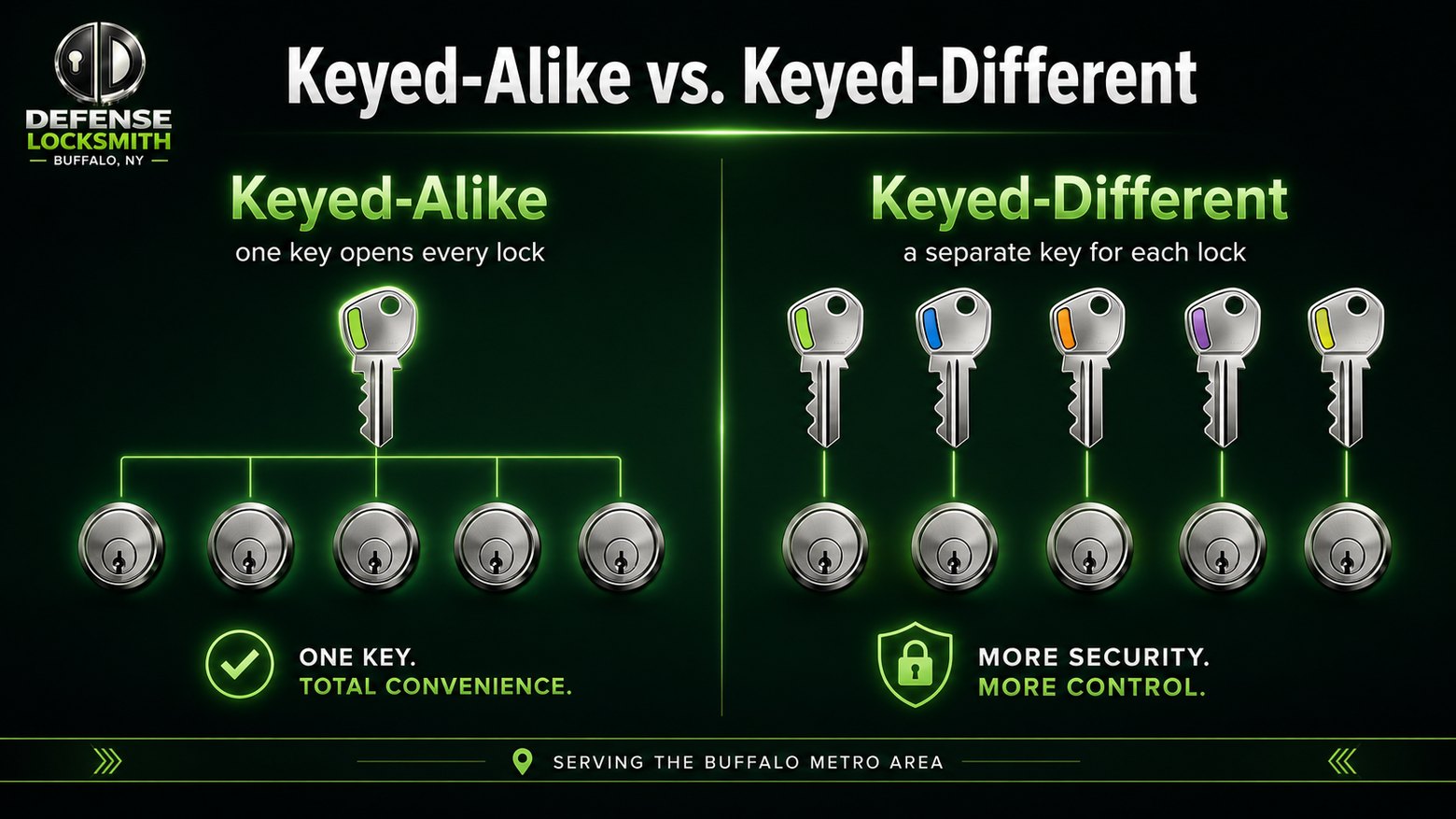
Restricted keyway. A patented keyway whose blanks are legally controlled — only authorized dealers can sell or cut them, so nobody makes an unauthorized copy at a hardware kiosk. This is the heart of key control: on a Medeco, Mul-T-Lock, or ASSA system, you decide who ever gets a working key. Ideal for landlords, home offices, and anyone who has handed out too many copies over the years.
Key control. The broader idea of governing who can duplicate and hold keys. It ranges from “Do Not Duplicate” stamps (which are a request, not a barrier) up to patented restricted systems (a real legal and physical barrier). If your keys have circulated among tenants, contractors, or exes, rekeying to a controlled system is the cleanest reset. Our property-manager services build these for landlords.
SmartKey and re-keyable cylinders. Kwikset SmartKey and Weiser equivalents let a homeowner reset the lock to a brand-new key in seconds using the current key and a small tool — no locksmith, no disassembly. It’s genuinely useful the day you move in or a tenant leaves. Understand the trade-off: the mechanism resists picking well but has known bypass concerns, so we treat it as convenience-grade, not high-security.
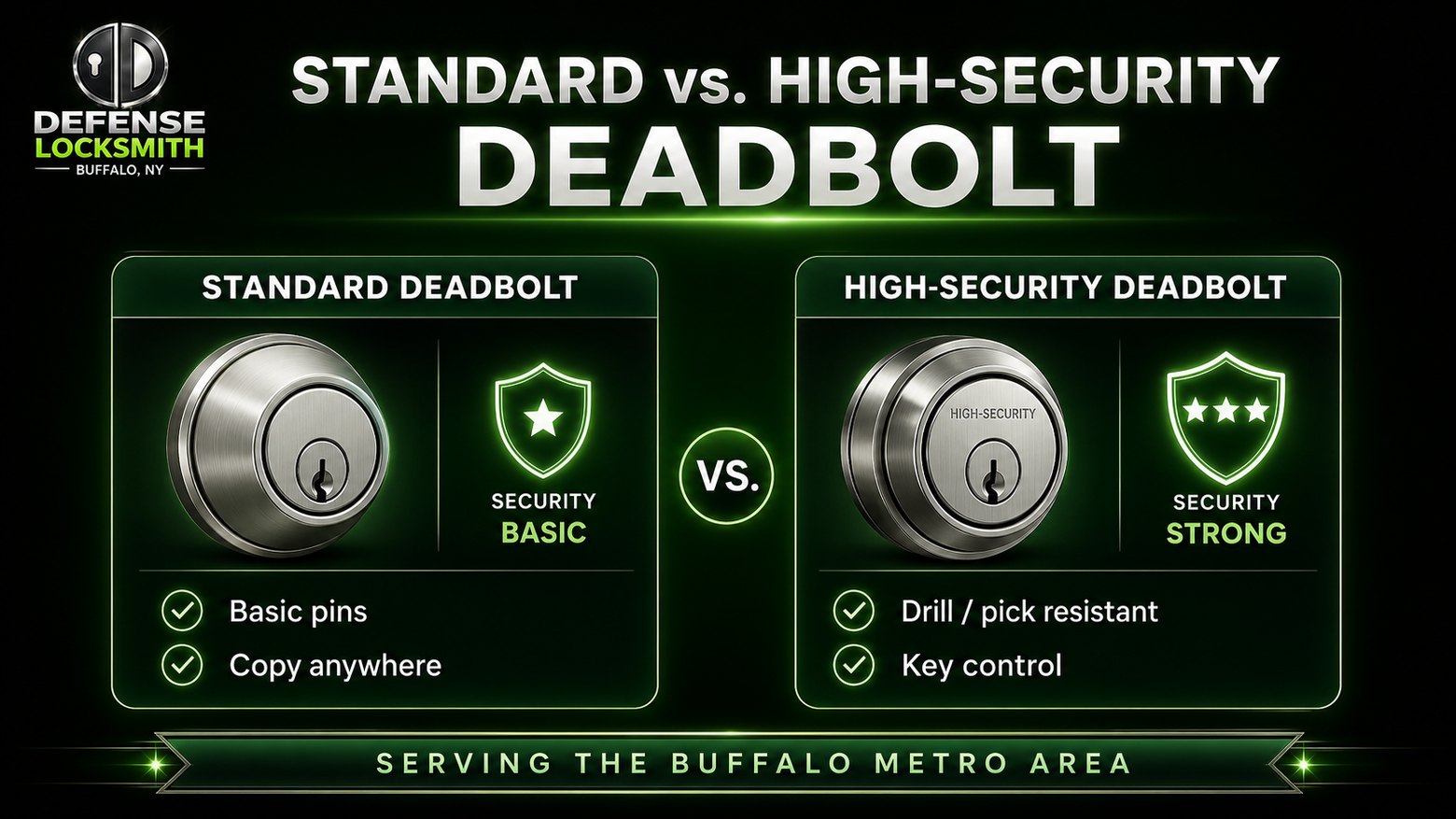
 Bump resistance. Lock bumping uses a specially cut “bump key” and a tap to bounce standard pins to the shear line. Security pins and tighter tolerances defeat it. Any lock you’re relying on for a main door should be bump-resistant — most quality Grade 1 and high-security cylinders are.
Pick resistance and security pins. Spool, serrated, and mushroom driver pins are shaped to catch and mislead a pick, dramatically raising the skill and time needed to open a lock. Sidebars (Schlage Primus, Medeco, Mul-T-Lock) add a second thing that must be solved at once. More security points equals more real-world resistance — and a longer, louder attack that burglars avoid.
High-security cylinder. A cylinder engineered against picking, bumping, drilling, and unauthorized duplication at once — typically UL 437 listed with a restricted keyway. This is the upgrade path when a standard deadbolt isn’t enough but you don’t want to replace the whole lock body: swap the cylinder, keep the hardware.
Reference Table 4: Smart Lock Connectivity
The biggest source of smart-lock confusion isn’t the lock — it’s how it talks to your phone and home. Here’s the whole landscape.
| Technology | Range / remote? | Hub needed? | Notes |
|---|---|---|---|
| Bluetooth | Phone-proximity only | No | Simple, battery-friendly; no remote control without a bridge. |
| Wi-Fi | Anywhere (remote) | No (uses your router) | Full remote control; uses more battery. |
| Z-Wave | Whole-home mesh | Yes (hub) | Low-power, reliable, great for smart-home systems. |
| Zigbee | Whole-home mesh | Yes (hub) | Similar to Z-Wave, 2.4 GHz mesh. |
| Thread / Matter | Whole-home mesh | Border router | The new interoperable standard; works across Apple, Google, Amazon. |
| NFC / UWB | Tap or precise proximity | No | Apple Home Key tap-to-unlock; UWB adds hands-free precision. |
Reference Table 5: Popular Smart Lock Models
| Model | Style | Unlock methods | Connectivity |
|---|---|---|---|
| August Wi-Fi Smart Lock | Retrofit (interior) | App, auto-unlock, keep your key | Wi-Fi + Bluetooth |
| Yale Assure Lock 2 | Deadbolt replace | Keypad, app, key (optional) | Swappable: Wi-Fi / Z-Wave / Matter |
| Schlage Encode Plus | Deadbolt replace (Grade 1) | Keypad, app, Apple Home Key, key | Wi-Fi + Thread |
| Kwikset Halo Touch | Deadbolt replace | Fingerprint, app, key | Wi-Fi |
| Level Lock+ | Invisible (inside deadbolt) | App, Apple Home Key, key | Bluetooth + Thread |
| Ultraloq U-Bolt Pro | Deadbolt replace | Fingerprint, keypad, app, key | Bluetooth (+ Wi-Fi bridge) |
| Aqara U100 | Deadbolt replace | Fingerprint, keypad, Home Key, key | Bluetooth + Thread/Matter |
| Eufy Smart Lock | Deadbolt replace | Fingerprint, keypad, app | Wi-Fi / Bluetooth |
Smart Locks, Explained
A smart lock is any lock you can operate without a traditional metal key — by app, code, fingerprint, tap, or voice — and usually monitor remotely. The category has matured fast, and for many Buffalo homes it’s now a genuine upgrade rather than a gadget. Here’s how to think about the pieces. If you’d rather have it installed and configured right the first time, we do smart lock installation across the metro.
Retrofit (interior-only) smart locks. These mount on the inside of your existing deadbolt and motorize the thumbturn — the outside of the door and your physical keys stay exactly as they are. The August Wi-Fi Smart Lock is the icon of this category. Renters love it because it’s reversible and doesn’t alter the exterior; you keep your key as backup. The downside is no keypad on the outside by default.
Deadbolt-replacement smart locks. These swap out the entire deadbolt for a unit with a keypad and/or fingerprint reader on the exterior. Schlage Encode, Yale Assure 2, Kwikset Halo, and Ultraloq live here. You get true keyless entry from outside — punch a code or touch a finger — and most keep an optional key cylinder as a backup. This is what most buyers picture when they say “smart lock.”
Keypad locks. Entry by PIN code. The killer feature is guest codes: a cleaner, a dog walker, an Airbnb guest, or a contractor gets a code that works only on schedule and can be revoked instantly — no copied keys floating around. Codes can be permanent, temporary, or one-time. Many keypad locks are also “dumb” (no internet), which some security-minded owners actually prefer.
Biometric / fingerprint locks. A capacitive fingerprint reader opens the door in well under a second — nothing to carry or remember. Quality units store prints encrypted on the lock itself and handle multiple fingers per user. Cold, wet, or worn fingertips can occasionally misread, which matters in a Buffalo winter, so always keep a code or key as backup. Ultraloq, Eufy, Aqara, and Kwikset Halo Touch are strong fingerprint options.
 Invisible smart locks. The Level Lock hides the entire motor inside the deadbolt bore, so the door looks completely ordinary — no bulky keypad, no obvious tech. You unlock by app, by Apple Home Key tap, or with a normal key. Perfect for people who want smart function without the “smart-home” look.
Unlock methods, summarized. Modern locks stack several: a physical key (backup), a PIN code, a fingerprint, a phone app, auto-unlock (the lock senses your phone approaching via geofence and Bluetooth), a tap-to-open NFC card or Apple Home Key, and voice (“lock the front door”) through Alexa, Google, or Siri. More methods means more convenience — and more things to keep updated and secured.
Matter and Thread. The important recent shift. Matter is an interoperability standard so a single lock works across Apple Home, Google Home, Amazon Alexa, and Samsung SmartThings without being locked to one app. Thread is the low-power mesh network many Matter locks use, which needs a “border router” you may already own (a HomePod mini, Apple TV, newer Echo, or Nest hub). If you’re buying today and want future-proofing, a Matter-over-Thread lock is the smart bet.
Power and batteries. Almost all smart locks run on AA batteries, typically lasting six months to a year. Good locks warn you well before they die and offer a backup: a physical key, or emergency 9-volt/USB-C contacts on the exterior to power the keypad long enough to enter a code. Never buy a keyless lock with no backup entry method.
Buffalo cold-weather reality. Western New York winters are the real test. Lithium AA batteries hold up far better than alkaline in deep cold; fingerprint readers can struggle with frozen or gloved fingers; and an exposed exterior keypad should be rated for the weather (look for an IP weather rating). We often recommend a lock with both a keypad and a physical-key backup here — redundancy matters when it’s minus-five and blowing off the lake.
“A smart lock doesn’t replace a good deadbolt — the best ones are a good deadbolt with a computer bolted on. When a customer asks me if they should go smart, I ask how they live. If you’re forever handing out keys and chasing them down, yes, codes will change your life. If you just want the door solid, buy mechanical and save your money. Neither answer is wrong.” — Simon Goodman, Defense Locksmith

AI & the Future of Residential Locks
“AI lock” is a marketing phrase attached to a lot of different things, so let’s separate the real advances from the hype. The genuine artificial-intelligence progress in home access is happening less inside the deadbolt and more in the cameras and software around it — and it’s changing what a “lock” even means.
Facial-recognition entry. Video doorbells and smart locks increasingly use on-device machine learning to recognize familiar faces and either announce who’s at the door or trigger an unlock. The best implementations run the recognition locally on the device (not in the cloud) for speed and privacy, and use liveness detection to tell a real face from a held-up photo. It’s convenient, but accuracy and bias vary by product, so treat face unlock as one factor, not the only one.
Palm-vein and advanced biometrics. Beyond fingerprints, newer systems read the unique vein pattern in your palm (the technology behind some retail “wave to pay” readers). Vein patterns are internal, hard to spoof, and work with dirty or worn fingertips — a promising direction for high-end residential access, though still early and pricey for homes.
AI person, package, and anomaly detection. This is where AI already earns its keep. Cameras paired with your lock can now tell a person from a passing car, a delivery from a prowler, and a familiar routine from an unusual one — and only alert you to what matters. Some systems learn your household’s normal patterns and flag anomalies: a door opened at 3 a.m., a code used at an odd hour, repeated failed fingerprint attempts. Fewer junk notifications, faster awareness of the real thing.
 Adaptive and geofenced access. AI-assisted automation unlocks (or arms) based on context — your phone’s location, the time of day, who’s home, whether a scheduled guest is expected. Done well it feels like the house anticipating you; done carelessly it can auto-unlock at the wrong moment, so good systems layer confirmation on top of convenience.
Apple Home Key, UWB, and the phone-as-key era. Ultra-wideband radios let a lock know not just that your phone is near but precisely where it is — approaching from outside versus sitting on the kitchen counter — enabling secure hands-free unlocking that’s hard to relay-attack. Tap-to-unlock with an iPhone or Apple Watch (Home Key) is already shipping on locks like Schlage Encode Plus, Level, and Aqara. The metal key is slowly becoming the backup, not the main event.
Voice assistants. Alexa, Google Assistant, and Siri can lock doors, check status, and include locks in routines (“Goodnight” locks everything and turns off the lights). For security, assistants will happily lock on voice command but require a spoken PIN or block voice unlock by default — a sensible guardrail worth keeping on.
The privacy trade-off. Every camera, cloud account, and biometric template is data about your home and family. Favor products that process biometrics and video on the device, store face and fingerprint data encrypted and locally, offer two-factor authentication on the app account, and publish a clear data policy. A connected lock is only as secure as the weakest account attached to it — use a strong, unique password and 2FA. Convenience is wonderful; it shouldn’t cost you control of your own front door.
Where it’s all heading. The near future is passive, layered, and interoperable: your door recognizes your phone or face as you approach, a camera confirms context, the system unlocks only when several signals agree, and everything works across whatever smart-home platform you use thanks to Matter. The humble deadbolt isn’t going away — it’s becoming one trustworthy layer inside a smarter whole.
Standards & Security Ratings
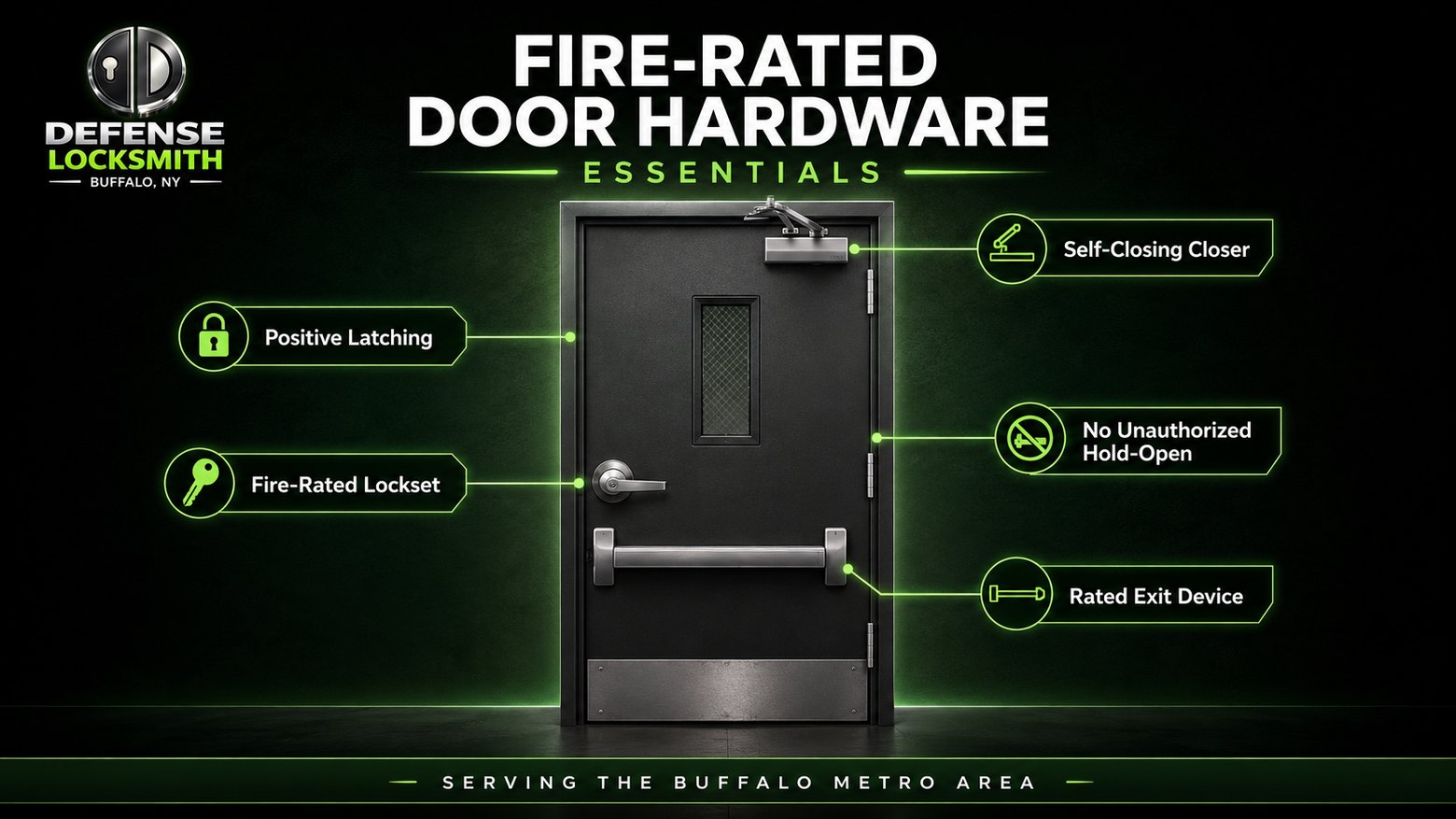
ANSI/BHMA grades (1, 2, 3). The American National Standards Institute and Builders Hardware Manufacturers Association jointly grade locks on operation, strength, and cycle life. Grade 1 is the toughest (commercial-level), Grade 2 is the residential sweet spot, Grade 3 is the builder-grade minimum. It’s the number to check first — but remember it measures durability and force resistance, not pick or bump resistance.
BHMA residential (AAA) rating. For consumer locks, BHMA also publishes a homeowner-friendly grade of three letters covering Security, Durability, and Finish — AAA being the best in each. It’s printed on many retail lock packages and is an easy at-a-glance quality check when you’re standing in the aisle.
UL 437. Underwriters Laboratories’ standard for high-security cylinders, testing resistance to picking, drilling, and forced entry for a sustained period. A UL 437 listing is a real high-security credential — you’ll see it on Medeco, Mul-T-Lock, ASSA, and similar. If a cylinder claims “high security” without a listing like this, be skeptical.
Operational, strike, and attack tests. Behind the grades sit specific bench tests: hundreds of thousands of open-close cycles for durability, repeated strike/impact blows to the bolt, and saw, pull, and torque tests against forced entry. A Grade 1 deadbolt simply survives more of each than a Grade 3. This is why grade correlates with how a lock holds up to a real kick or pry, not just to a picker.
 IP weather ratings. For anything with electronics outdoors — keypads, fingerprint readers, smart locks — an Ingress Protection (IP) rating tells you its resistance to dust and water. It matters a lot in Buffalo; an exterior keypad exposed to lake-effect weather should carry a solid IP rating so snow, ice, and rain don’t kill it.
How to Choose: A Buffalo Homeowner’s Guide
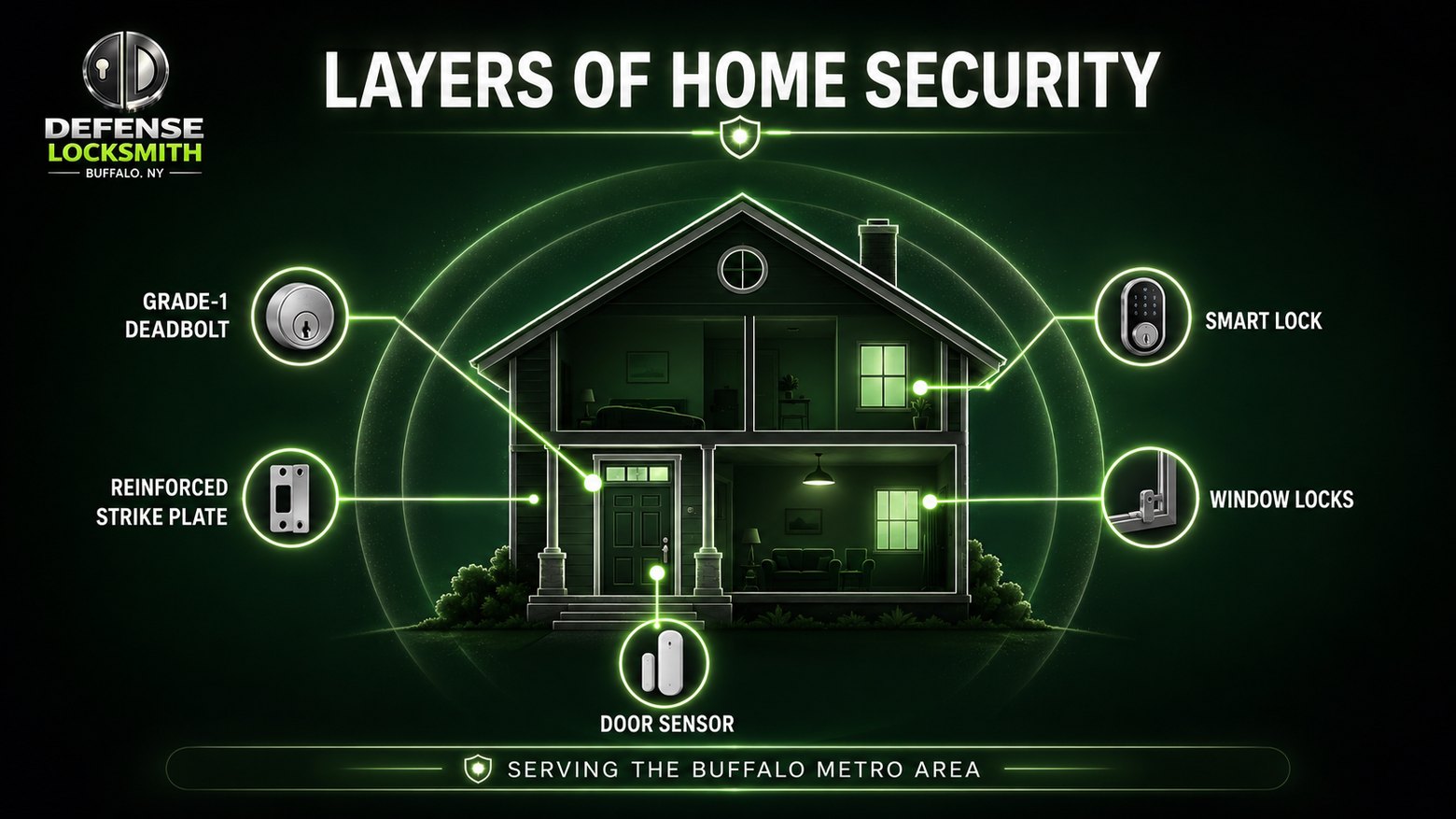
Start with the door, not the lock. The strongest deadbolt is useless in a rotted jamb or a hollow door with a half-inch strike screw. Reinforce the strike with 3-inch screws into the stud, add a strike-plate reinforcer or door shield, and make sure the bolt fully throws. This $15 of hardware stops more break-ins than a $150 lock upgrade alone.
Match the grade to the risk. Grade 1 or a solid Grade 2 deadbolt on every exterior door; Grade 2 or 3 is fine on low-risk side and interior doors. Don’t overspend on a shed and underspend on the main entry — the front and back doors are where it counts.
Decide how much “smart” you actually want. If you hand out keys constantly — kids, cleaners, rentals, guests — a keypad or app lock with revocable codes pays for itself in convenience and control. If you just want a bulletproof door and hate accounts and batteries, a high-security mechanical deadbolt is the answer. Both are valid; buy for how you live.
Think about the whole ecosystem. If you’re an Apple household, a Home Key / Matter lock is seamless. On Google or Alexa, check compatibility before buying. A Matter-over-Thread lock hedges your bets across platforms and is the most future-proof pick today.
Plan for winter and for backups. Choose lithium batteries, a weather-rated exterior unit, and always a backup entry — a key cylinder or emergency power contacts. Redundancy is not optional in a climate that hits the extremes ours does.
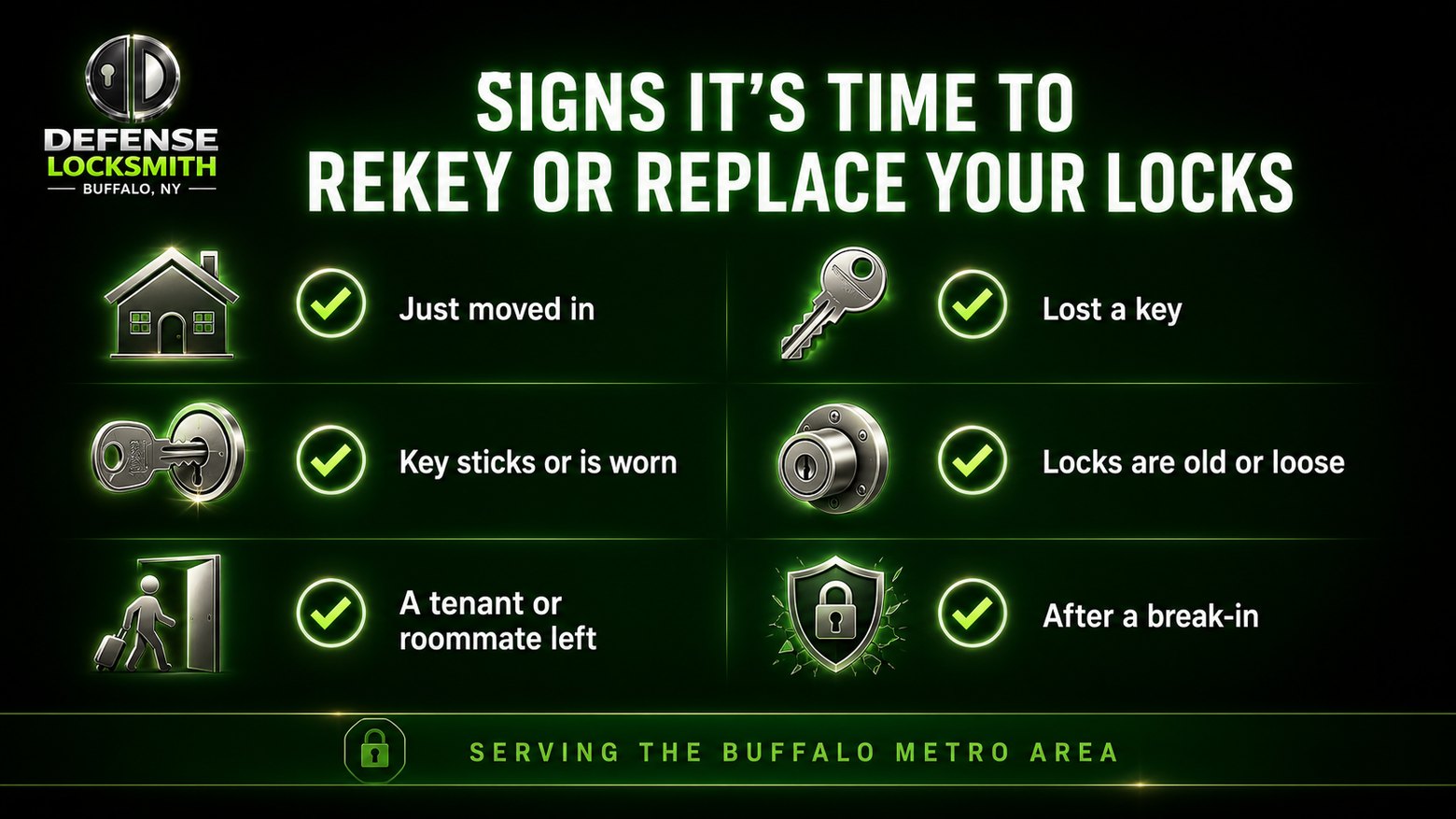
Rekey instead of replacing when you can. Moved in, lost a key, or a tenant left? You usually don’t need new locks — a quick rekey makes every old key useless for a fraction of the cost. Save replacement for locks that are worn, damaged, or being upgraded.
“The best lock is the one you’ll actually use correctly every day. I’ve seen thousand-dollar smart systems left unlocked because they annoyed the owner, and I’ve seen a $70 Grade 1 deadbolt protect a family for twenty years. Pick something that fits your door, your climate, and your habits — then use it. That’s real security.” — Simon Goodman, Defense Locksmith
Frequently Asked Questions
Are smart locks safe from hackers? A quality smart lock from a reputable brand, with a strong unique password and two-factor authentication on the app, is safe for the overwhelming majority of homes — burglars still overwhelmingly go through doors, windows, and frames, not networks. The bigger real-world risks are weak passwords, dead batteries with no backup, and poor installation. Secure the account, keep a backup entry, and mount it properly.
What’s the most secure residential lock? For pure resistance to picking, bumping, and drilling, a UL 437 high-security deadbolt with a restricted keyway — Medeco, Mul-T-Lock, or ASSA — is the top tier. But “most secure” always includes the door, frame, strike, and hinges around it. A great lock on a weak door isn’t secure.
 Should I get Schlage or Kwikset? Schlage generally wins on raw deadbolt strength and is our default for a main door. Kwikset wins on value and the convenience of SmartKey self-rekeying, which is great for renters and new homeowners. Both make good and bad products — check the grade on the box.
Do smart locks work in Buffalo winters? Yes, with the right choices: lithium batteries, a weather-rated (IP-rated) exterior unit, and a backup entry method. Keep fingerprints as a secondary, not sole, method since cold and gloves interfere with readers.
Can you rekey a smart lock? If it has a physical key cylinder as backup (most do), yes — the mechanical cylinder rekeys like any other, and codes and app access are managed separately in the app. We handle both.
Is a double-cylinder deadbolt worth it? Only in specific cases (glass right beside the lock), and even then weigh the fire-escape risk carefully — many codes restrict them on egress doors. A single-cylinder deadbolt plus reinforced or laminated glass is usually the safer overall choice.
Talk to a Real Buffalo Locksmith
Still not sure which lock fits your door, your budget, or your winter? That’s what we’re here for. Defense Locksmith installs, repairs, rekeys, and upgrades every brand and type in this dictionary — mechanical, high-security, and smart — anywhere in the 50-mile Buffalo metro, owner Simon Goodman on the tools. Call or text (716) 803-2934 for straight advice and a real quote. Explore our residential locksmith services, smart lock installation, and rekeying — or brush up on terms in our complete locksmith dictionary.